
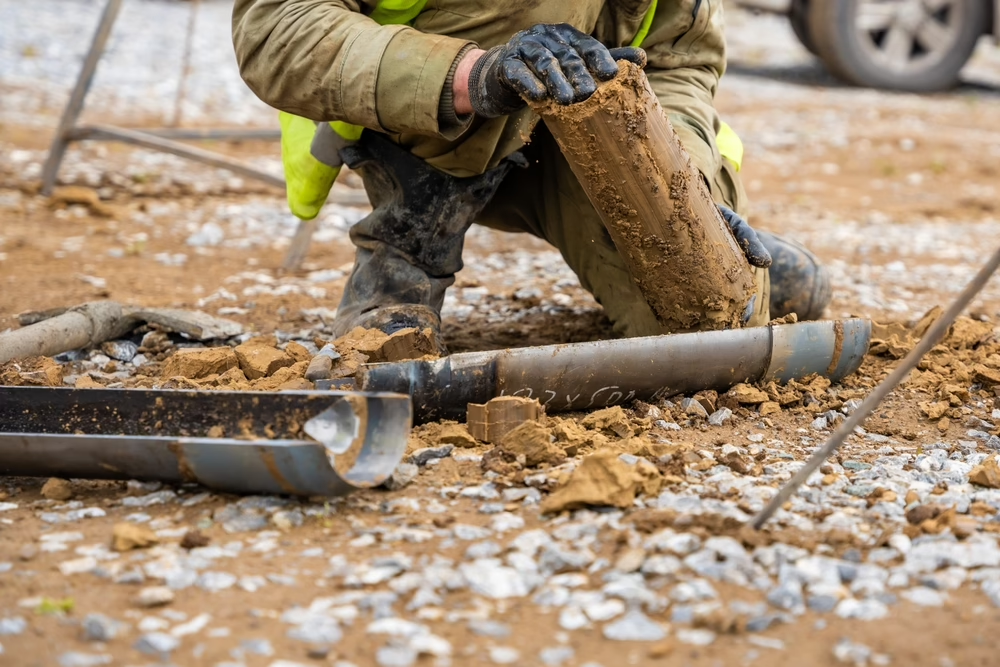
Every successful project begins with an understanding of the ground directly underneath it. While structural and civil engineers focus on designing roads, bridges, and buildings, geotechnical engineering provides the framework required to support these concrete and steel structures. By analyzing the unpredictable nature of soil and rock, geotechnical engineers bridge the gap between structural design and the earth, making sure that structures remain stable over time.
The Intersection of Geotechnical and Structural Engineering
Without a proper subsurface analysis, even the most advanced structural designs can become compromised . The relationship between structural engineering and geotechnical engineering is symbiotic; structural designs are only as dependable as the ground supporting them.
A geotechnical engineer evaluates how earth materials behave when subjected to loads. During the initial planning phases, this collaboration is essential for determining project feasibility and dictating the overall foundation design parameters.
Historically, the absence of well planned subsurface testing has led to structural failures. Today, strict engineering standards mandate ground testing before construction permits are issued, eliminating dangerous guesswork and protecting public safety.
Pre-Construction Analyses and Site Investigations
Long before construction crews pour concrete or mobilize heavy machinery, geotechnical engineers lead in-depth site investigations to map the subterranean conditions.
To bridge the gap between initial field data and municipal compliance, developers rely on specialized oversight. As a geotechnical engineering firm, Earth Engineering Incorporated transitions these subsurface insights into code-compliant, field-verified data that satisfies both engineering requirements and local regulatory mandates.
Subsurface Mapping Techniques
- Test Borings: Extracting soil and rock core samples to analyze subsurface stratigraphy.
- On-Site Testing: Utilizing specialized field equipment to measure soil density, permeability, and shear strength.
- Laboratory Testing: Conducting analyses, including:
- Sieve Analysis: Determining grain size distribution to classify soil types like gravel, sand, silt, or clay.
- Atterberg Limits: Measuring moisture thresholds to evaluate soil plasticity, expansion potential, and shrinkage behavior.
- Direct/Triaxial Shear Testing: Measure of the shear strength of the subsurface materials.
- Unconfined Compressive Strength Testing: Measure the soil/rock strength.
Risk Mitigation and Budget Control
This early scientific testing reveals how the ground will react to structural loading . It identifies hidden geological hazards such as voids, fault lines, loose/soft soil layers, and uneven subsurface conditions.
By identifying these variables during the design phase, the project team can modify structural designs early. This reduces safety hazards, structural failures, and helps to protect developers from cost overruns or construction delays.
Foundation Design and Structural Selection
The engineering data gathered during site investigations dictates which type of foundation system is needed.
| Foundation Type | General Subsurface Condition | Typical Engineering Applications |
| Shallow Foundations (e.g., Spread Footings, Mat Foundations) | Adequate-bearing capacity soil near the surface; low risk of settlement. | Low-to-medium-rise residential and commercial buildings. |
| Ground Improvements (e.g., Dynamic Compaction, Aggregate Piers, Rigid Inclusions) | Questionable soils where improved bearing capacity and/or settlement control is required | Low-to medium-rise buildings, industrial, and bridges. |
| Deep Foundations (e.g., Driven Piles, Drilled Shafts/Caissons) | Weak/deep upper soil layers; deep bedrock or highly compressible strata. | Medium to High rise, heavy industrial, and bridges. |
For major infrastructure like bridges, the geotechnical engineer plays an even more specialized role. Bridge piers and abutments must resist intense lateral forces from wind and moving water. Geotechnical experts evaluate the type of foundation system, depth, and size required to support the bridge into stable, deep geological strata.
Slope Stability Analysis and Earth Retention
When civil engineering projects require building on hillsides, steep terrain, or near embankments, managing the risk of landslides and soil movement becomes a primary safety priority. Geotechnical engineers perform rigorous slope stability analyses to make sure the earth remains stable.
Engineers evaluate the soil’s shear strength. Water acts as a lubricant between soil particles, increasing pore water pressure and significantly reducing shear strength. By evaluating groundwater conditions, geotechnical engineers can design effective subsurface drainage systems to alleviate this pressure.
To verify slope safety, engineers utilize advanced computer modeling software to simulate various failure scenarios. They calculate a safety factor. If this safety margin is insufficient, the geotechnical engineer designs earth retention structures and implements soil stabilization techniques, including:
- Retaining Walls: Structural barriers engineered to resist lateral earth pressure.
- Soil Nailing: Inserting steel reinforcing bars into slopes and grouting them in place.
- Geosynthetics: Utilizing high-strength polymer geotextiles to reinforce and bind soil layers.
Hydrogeology
Managing groundwater conditions is one of the most volatile variables on a construction site. High water tables generate substantial hydrostatic pressure, which can crack concrete slabs, flood basements, or even cause entire structures to experience buoyancy issues where the structure is pushed upward.
Geotechnical reports detail these water levels, guiding engineers, architects, and contractors in selecting waterproofing membranes, foundation drainage systems, and temporary dewatering methods required during excavation.
Ground Improvement and Modern Solutions
When the natural engineering properties of a site are poor, geotechnical engineers do not necessarily abandon the location. Instead, they implement ground improvement techniques to modify and strengthen the existing earth:
- Chemical Stabilization: Mixing lime, cement, or fly ash into weak soils to increase shear strength and reduce plasticity.
- Dynamic Compaction: Dropping heavy weights from designated heights to densify loose, granular soils.
- Vibro-Compaction/Aggregate Piers: Using vibrating probes to compact deep layers of loose soils or compacting layers of aggregate piers, significantly raising its bearing capacity.
Beyond new construction, these professionals act as critical problem-solvers for existing infrastructure. If an older or historic building begins to settle unevenly, a geotechnical engineer designs corrective systems such as underpinning/pin piles (extending the foundation depth to stronger soil) or compaction grouting to stabilize the structure.
Partner with Earth Engineering Incorporated
Building with confidence starts with knowing exactly what lies beneath your site. Earth Engineering Incorporated (EEI) provides the expert geotechnical engineering in NJ and surrounding regions that is required to lay the groundwork for your project’s long-term success. Our full-suite services include geotechnical investigations, geostructural design, sinkhole consulting, and in-house laboratory soil testing. Don’t leave your structural integrity or your project budget to guesswork.
Contact Earth Engineering Incorporated today to schedule your pre-construction subsurface analysis.