
Owning a home can offer plenty of joy, but underlying structural issues can quickly ruin that experience and lead to significant financial stress. You might spot a jagged crack running down your basement wall or notice a door rubbing against its frame. These subtle changes can indicate serious foundation problems that demand professional attention. Ignoring these warning signs can lead to expensive property damage in the future, as structural instability rarely resolves itself.
Structural stabilization becomes necessary when there is visible degradation of the exterior appearance of your home. The soil beneath your home should have the capacity to bear the weight of the structure; otherwise, there will be movements which put pressure on the frame. The movement caused by settlement may be uniform but, more often than not, is differential, which means that one side of the home settles faster than the other. This uneven movement causes the most significant damage to the architectural integrity of your home.
Professional structural engineers emphasize that the longevity of a building depends entirely on the stability of its base and footings. If you are noticing persistent issues with your home’s alignment, it is time to conduct a thorough investigation. By taking a proactive approach, you will be able to identify the extent of work required.
When a house begins to settle unevenly, the entire structure sends out distress signals throughout your living area and exterior:
- Sloping Floors: Feeling a distinct slant as you walk across your main level.
- Frame Gaps: Wide gaps appearing around your window and door frames.
- Drywall Cracks: A sudden increase in interior drywall cracks, indicating active movement.
- Cracks: Classic diagonal cracks in exterior facade and cracking in basement walls.
Should you notice any significant wall cracks , or if you observe the exterior distress , be sure to seek professional assistance. At Earth Engineering Incorporated, our expert team specializes in forensic engineering assessments, pinpointing the geotechnical factors driving structural distress to deliver engineered solutions for underpinning design in PA and the surrounding region.
What Causes a Home to Shift and Sink?
There are various factors that will determine how your property interacts with the subsurface conditions. Poor soil quality is the main cause of serious structural movement. For example, constructing a structure on loose soil or fill materials can result in movement over time.
Understanding How Concrete Underpinning Works
This method helps increase the strength of your structure through deepening of the existing footing base so it bears on more stable soil. Foundation underpinning design involves excavating sections beneath the footing and placing concrete to create a solid base. The concrete underpinning makes sure that the load is distributed to a suitable bearing strata resulting in an effective permanent foundation repair.
In the course of the excavation procedure, the contractor usually works in stages in order to keep the structure stable during the process. Staging allows the house to remain stable and not collapse as the soil underneath is excavated. After the curing of the concrete, it becomes an important component in supporting the structure.
Determining the Answer: Do I Need Underpinning for My Home?
If you plan to dig out a basement to increase ceiling height or construct a basement adjacent to an existing structure, your contractor must stabilize the surrounding excavation. A major vertical addition can also add significant weight that your existing foundation cannot safely support. In these cases, underpinning is almost always necessary to make sure the new loads are safely supported.
The process of underpinning the foundation makes sure that the structure remains stable as you increase its usable space.
The Standard Repair Process
- Excavation and Preparation: Workers dig beneath the footings in controlled stages to expose the existing footing safely, removing soil.
- Pouring the Materials: The team fills the newly excavated space with high-strength concrete to create a base for the underpinning foundation.
- Transferring the Load: After curing, the weight of the house transfers directly to the new structural supports permanently, completing the foundation repair.
Comparing Helical Piers and Other Solutions
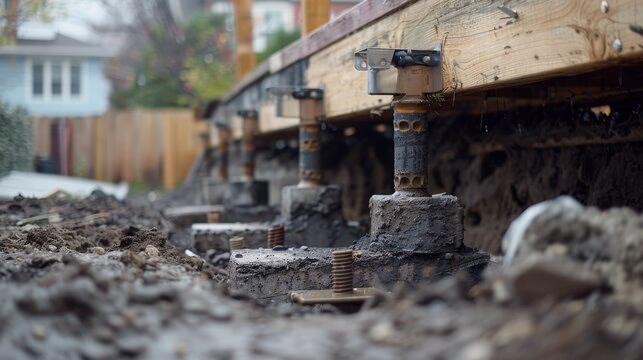
Modern technology provides many ways of underpinning structures. The helical pier system works just like large screws drilled deep into the soil until it reaches soil capable of bearing loads. This solution is recommended especially in places with restricted access to excavators.
A single helical pile is capable of carrying a significant amount of weight to stabilize the building. Adding additional helical piles next to the compromised area provides capacity to stabilize the building.
Another solution that can be considered is the installation of push piles. These elements are steel piers which are hydraulically pushed through the soil into a competent bearing strata in order to provide support to the building.These piers can be used to stabilize the structure and possibly raise the foundations back into place.
Although concrete solutions can serve adequately when the depths involved are not too great, deeper elements such as helical piers or push piles may be more appropriate Evaluation of the existing conditions will determine whether your soil requires concrete or piers.
The Financial Impact of Foundation Failure
Disregarding the necessity of stabilizing your structure could lead to consequences both for the property value. Many people hesitate when it comes to buying a house which needs an underpinning foundation because they are concerned about unforeseen expenses.
When you address these problems, you are not only correcting the problems but safeguarding your investment. A house that has undergone stabilization for the same is much more valuable to sell than one that has been neglected.
Secure Your Foundation Today
Determining if you need an underpinning foundation requires careful observation and professional expertise. By recognizing the early signs of distress and understanding the causes, you can take action before the damage becomes unmanageable. Whether you choose traditional concrete methods or modern helical piers/push piles, the goal of foundation repair remains the same: to provide a safe, stable, and lasting base for your home.
Don’t let foundation issues compromise the safety and value of your property. If you think you need foundation underpinning design in NJ or the surrounding region, contact Earth Engineering Incorporated today to schedule a professional evaluation with our expert engineering team and secure your home’s structural future.